A destination wedding invitation has two jobs: to invite, and to tell guests everything they need to book flights, rooms and outfits for several days away. The wording is the easy part. What matters is splitting the information sensibly, with dates on the save-the-date, the formal invitation on the main card, and functions, travel and dress codes on separate cards or a wedding website.
Below are templates you can copy and adapt for each piece, plus the wording that trips families up most often: the host line, the multi-function schedule, WhatsApp invitations and guests flying in from abroad.
Key Takeaways
- Send save-the-dates for a destination wedding eight to twelve months ahead, earlier if guests need visas or your dates fall in peak season.
- Put only the names, dates and destination on the save-the-date; the venue, schedule and dress codes can follow with the invitation.
- Use one formal card for the wedding itself and a separate schedule card (or website page) for every function.
- Name the hosts the way your families actually host: parents, grandparents, or the couple together with both families.
- For guests abroad, add a travel and stay card that covers the nearest airport, room blocks, transfers and the RSVP deadline.
- A WhatsApp invitation works for most guests, but elders and close family should still hear from you personally first.
What should a destination wedding invitation include?
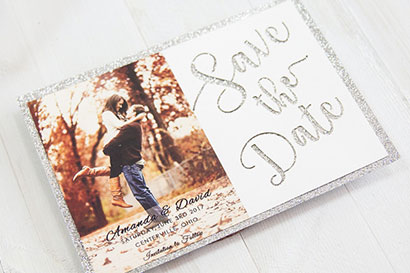
Think of it as a set rather than a single card. A complete destination invitation set covers:
- The hosts and the couple: who is inviting, and whose wedding it is.
- The destination and dates: city and venue, and the full span of days, not only the wedding day.
- The function schedule: each event with date, time, venue within the property and dress code.
- Travel and stay: nearest airport, room block or hotel details, transfers, and a contact for logistics.
- RSVP: a firm date and a single way to reply, ideally with arrival and departure details.
- The website or QR code: the place where details live and can be updated.
The main card should stay formal and uncluttered. Everything practical goes on the inserts or the website, which is also where you can make changes without reprinting anything.
When should you send save-the-dates and invitations for a destination wedding?
Send save-the-dates eight to twelve months before a destination wedding, the window WeddingWire’s save-the-date timing guide recommends for weddings that involve travel. Send the formal invitation once room blocks, the function schedule and transfers are confirmed. In our experience, that is usually about three months out.
| Piece | When to send | What it must carry |
|---|---|---|
| Save-the-date | 8–12 months before | Names, dates, city or country, “invitation to follow” |
| Formal invitation | About 3 months before | Hosts, couple, wedding day, venue |
| Schedule and dress code card | With the invitation | Every function, timing, dress code |
| Travel and stay card | With the invitation | Airport, rooms, transfers, RSVP date |
| Final itinerary (digital) | 2–3 weeks before | Pick-up times, room numbers, contacts |
Go earlier than this if many guests need visas, if your dates fall in peak wedding season, or if the destination has limited flights. This is the part couples tend to underestimate: a guest who cannot get leave or a visa in time will not be able to come, however beautiful the card.
Save-the-date wording
Keep it short. The aim is to secure the dates in your guests’ calendars, not to explain the wedding.
Family-hosted, formal
Together with their families
[Bride’s name] & [Groom’s name]
request that you save the dates
[Day]–[Day] [Month] [Year]
[City], [Country]
Formal invitation to follow
Couple-hosted, modern
We’re getting married in [City]!
[Name] & [Name]
[Dates]
Book your leave, and we’ll send the rest soon.
[Wedding website]
Short digital version
Save the dates: [Name] & [Name], [Dates], [City]. Three days of celebrations, invitation to follow. Details at [website].
If your venue is confirmed and you want guests to book early, add one line with the venue name. Leave out function times until they are final; changing them later causes more confusion than leaving them off.
Formal invitation wording
Indian invitations usually name the hosts first. Use the version that reflects how your families are actually hosting the wedding.
Hosted by the bride’s parents
Mr & Mrs [Bride’s parents’ names]
request the pleasure of your company
at the wedding of their daughter
[Bride’s name]
with
[Groom’s name]
son of Mr & Mrs [Groom’s parents’ names]
on [Day, Date]
at [Venue], [City]
Hosted by both families
With the blessings of our elders,
the [Family name] and [Family name] families
invite you to celebrate the marriage of
[Bride’s name] & [Groom’s name]
[Day, Date] · [Venue], [City]
Celebrations begin [Date] and continue through [Date]
Hosted by the couple
[Name] & [Name]
together with their families
invite you to join them in [City]
for their wedding celebrations
[Dates]
The “with the blessings of” line is where many families name grandparents or late elders. Keep it to one line; a longer family roll call belongs on a separate “with best compliments” insert, as covered in our guide to wording a wedding invitation.
How do you word the function schedule?
A multi-day destination wedding needs a schedule card. List functions in order, give each its own date, time, place and dress code, and keep the language consistent.
The Celebrations
Welcome Lunch: [Date], 1 pm · [Venue space] · Resort casual
Mehendi: [Date], 4 pm · [Venue space] · Colours of the garden
Sangeet: [Date], 8 pm · [Venue space] · Indian festive
Haldi: [Date], 10 am · [Venue space] · Yellow, and clothes you don’t mind getting stained
Wedding: [Date], muhurat at [time] · [Venue space] · Indian formal
Reception: [Date], 8 pm · [Venue space] · Black tie or Indian formal
Two details make this card far more useful. First, say what the dress code means in practice (“Indian festive: lehengas, sarees, sherwanis, kurtas”), because international guests and younger cousins will ask. Second, if a function is outdoors, add a line on footwear or evening temperature. A guest in heels on a lawn, or in silk on a cold desert evening, will notice.
Some families send separate cards for functions that only close family attend. That is a sensible way to manage numbers without awkward conversations.
Travel and stay card wording
This card does the most practical work, especially for guests flying in.
Getting there
Nearest airport: [Airport name], [time] from the venue
Arrivals on [Date] will be met and transferred to [Hotel]Staying with us
Rooms are held for you at [Hotel] from [Date] to [Date]
Please share your flight details by [Date] so we can plan your transfersRSVP by [Date] at [website / contact name and number]
If guests will stay across more than one hotel, say which guests are where on the website, not on the printed card. Room allocations change, and print does not. For more on what guests need once they arrive, see our notes on planning a destination wedding for your guests.
WhatsApp and digital invitation wording
Most families now send a digital invitation alongside or instead of print. Pair the e-card or video with a short, warm message. The design carries the formality, so the message can be personal.
Dear [Name],
We would love for you to be with us in [City] from [Date] to [Date] for [Name] & [Name]’s wedding. The invitation is attached, and all the details, including travel and stay, are at [website].
Please RSVP by [Date]. With love, [Your names]
For elders and close family, call or visit first and send the digital card afterwards. In many families, an invitation that arrives only as a forward will be remembered for the wrong reasons.
Wording for NRI guests, mixed languages and different traditions
Guests travelling from abroad. Add one plain line to the save-the-date or website: “If you need a visa to travel to [Country], please start the process early.” Do not give visa advice on the card. Point guests to the destination’s official immigration or embassy website and let them check what applies to them.
Two languages. Many families print Hindi, Gujarati, Punjabi or another language on one side and English on the other. Keep the information identical on both sides, and have a native speaker check the wording, especially names and honorifics.
Interfaith and multi-tradition weddings. If you are holding two ceremonies, name both on the schedule card in the order they will happen, and add a short line explaining each for guests who may be unfamiliar with them.
Anand Karaj. For a Sikh wedding at a gurdwara, mention the timing of the ceremony clearly and add a gentle note that guests will be asked to cover their heads, so they can come prepared.
Gifts. If you prefer no boxed gifts, say it once, kindly: “Your presence is our blessing. We request no boxed gifts.” For a destination wedding, many guests will appreciate knowing not to carry anything.
Common destination invitation mistakes
- Function times on the save-the-date. They will change. Leave them off.
- One card trying to do everything. It gets crowded and guests still miss the RSVP date.
- No arrival and departure question in the RSVP. Without it, transfers and room nights become guesswork.
- Dress codes without examples. “Festive” means different things to different guests.
- No single source of truth. If the website, the card and the WhatsApp message disagree, guests will follow whichever one they saw last.
Frequently asked questions
How early should you send a destination wedding invitation?
Send save-the-dates eight to twelve months before the wedding and the formal invitation about three months before, once room blocks, the schedule and transfers are confirmed. Go earlier if many guests need visas or you are marrying in peak season.
What should a destination wedding save-the-date say?
The couple’s names, the dates, the destination city or country, and “invitation to follow”. You can add the wedding website and the venue name if confirmed. Leave function times and dress codes for the invitation.
Who should be named as hosts on an Indian wedding invitation?
Whoever is actually hosting: often the bride’s parents, both sets of parents, or the couple together with their families. Grandparents and late elders are usually honoured in a “with the blessings of” line at the top.
Is a WhatsApp wedding invitation acceptable for a destination wedding?
Yes, for most guests, provided it includes the e-card, the dates, the website and an RSVP date. Elders and close family should hear from you personally first, by phone or in person.
How do you mention the dress code for each function?
Put it on the schedule card next to each event, with a short example of what it means, for example “Indian festive: lehengas, sarees, sherwanis”. Add notes on footwear or evening temperatures for outdoor functions.
Planning the invitations for a destination wedding
Get the information right first, then the design. Once the dates, venues, rooms and functions are settled, the wording follows easily. Leaving gaps in those details is what makes invitations hard to write.
Our branding and gifting team designs invitation suites, inserts and welcome hampers as part of the wider wedding identity, and our destination wedding planning team handles the travel and stay details that go on the cards. Still choosing a destination? Our Jaipur wedding venues guide and the destination wedding checklist are good places to start.